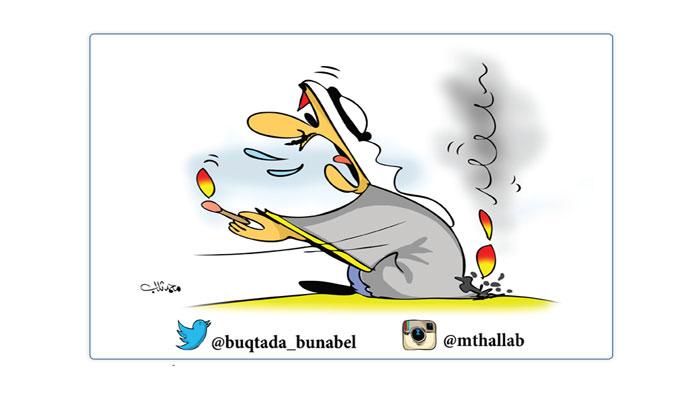
Conquests: Between obligation and rejection
M. Bitar,Samir Sadek
The conquests proved in the end that they were like other colonial wars and exploitative holy wars! Essentially, there is no difference between all these forms of wars, In terms of justification, there is no war of occupation or conquest without fabrication, except that the justifications for the conquests differed somewhat from the justifications for traditional colonialism!
The first fundamental difference relates to the concept of jihad, which promoted the nobility and sanctity of these conquests, and then the divine mandate to spread the true religion, despite the acknowledgment that there is no compulsion in religion! To you your religion, and to me my religion! Here, the use of the sword and violence in the process of preaching and spreading the religion clashed with the claim of no compulsion, Then, is it consistent to preach the new religion and spread it with the practice of enslavement, imposing the tribute, and then kidnapping Egyptian, Berber, Spanish, and other women from the conquered countries to work as concubines in the palaces of the caliphate and with those who enslaved and kidnapped them? And are the virtues of morality completed with actions of this kind?
The alleged divine mandate did not include the perpetration of all these crimes, Therefore, the conquests can and should be considered acts of plunder and pillage, an extension of what the Bedouin tribes of the Arabian Peninsula practiced before the birth of this religion, The tribes lived off raids and war booty, and the new religion militarily united these tribes to carry out “conquests” outside the Arabian Peninsula, Then, it fabricated additional justifications for the tribes addicted to raiding, such as the sanctity of spreading the religion and the necessity of jihad to the death to gain eternal life in the afterlife in heaven between the thighs of the houris. Death, they claim, was also in the path of God , We do not know a valid reason for the necessity of a human being, created by God, dying in the path of God and in order to pass from this mortal life to eternal life, and to be exclusively preoccupied with breaking the hymens that are renewed daily in Paradise with the houris in numbers and forms beyond imagination, Even the virginity of the houris was a guaranteed reward for every warrior in the path of God and His religion,And how can one deal with virginity when there is no hymen in the first place? Like the appendix, it is a representative of embryonic remnants that have no function after birth, and it does not even have a biological existence in all female creatures.
What distinguishes the conquest from the utilitarian colonial occupation was the factor of religious obligation to complete the formation of the supreme Muslim, according to the hypothesis of the Tunisian thinker Yahya Ben Salama, which reminds us of the concept of the “superego” in Freud, Ben Salama noted the increased level of torment of regret for not being a Muslim as he should be, which requires more religious practices, even sacrificing the worldly self, i.e., martyrdom, burning with the desire to sacrifice with the aim of transforming into a superhuman being, but one distinguished by a severe disturbance and disruption in recognizing the boundaries between the self and the non-self, between the real and the unreal, between life and death, which facilitates the act of self-sacrifice after the actual death is negated in terms of its meaning, significance, and reality, They do not die, but are alive with their Lord, receiving sustenance!
The fabricated death presented as voluntary, i.e., martyrdom, appears to be a more insidious imposition than the material need imposed by traditional colonialism, such as England’s colonization of India and other countries, The utilitarian need in the traditional form of colonialism seems limited, unlike the more comprehensive religious imposition, because the religious imposition is concerned with humanity wherever it may be, Therefore, it is the highest duty of the Muslim to bring every human being into the fold of the true religion, because this religion is the only religion of God, and every human being needs this religion to guarantee salvation to the eternal afterlife, Here we ask about the necessity of the fundamental pillar of jihad in religion, When all of humanity converts to the one religion of God, then jihad theoretically loses its necessity! Can religion remain alive on earth after losing one or more of its pillars, or will religious figures invent new justifications for the continuation of jihad?
It seems practically that the need for jihad, i.e., conquest, will continue, and nothing stands in its way except the inability to practice it, Therefore, external conquests stopped, and nothing remains of their culture except lamenting them, The world, on the contrary, is very happy about the inability to carry out external conquests, Imagine several hundred million Bedouin Arabs possessing the capabilities of a similar number of millions of Americans militarily, economically, and politically, What would the state of the world be then? The inability to be able to do so externally has turned the corner of jihad into the internal, which we are now experiencing as endless conflicts between believers, greater and more violent than jihad against the infidels.
The conquests should be viewed as a historical reality that oscillates between revelation on one hand and reality on the other, Humans and their efforts must resort to revelation at times and to reality at other times, or to both together, according to the need and circumstances, Resorting to revelation negates the need for additional justifications, because the word of God is in itself the justification for itself, and there is no need for the word of God to be logical according to religious standards, because the word of God is originally the standard for everything!
The relationship between reality and revelation was one of mutual support, solidarity, and integration, Revelation supported reality according to necessity and circumstances,The reality of the hypothetical Byzantine threat to the Caliphate had a great impact on the conquest of the Levant, while revelation did not have a great impact on the conquest of Persia, Here, the lust for theft or the acquisition of the treasures of Khosrow played the main role, Likewise, the matter of Spain was similar after the exploratory tour carried out by the Berber Tarif, where he proved that there was something that could be stolen in the Iberian Peninsula, The matter was similar with regard to the Nile Basin, Mesopotamia, and others.
There was a kind of balance between reality and revelation regarding the financial resources of the treasury, Revelation sought the conversion of all non-believers to Islam, while reality allowed for the existence of non-believers, This was because the non-believers and the jizya (tribute) they were required to pay in humiliation constituted the primary source of the Islamic state’s finances, alongside plunder, theft, and war booty, The conquerors lacked other means of funding, such as oil, industry, or even agriculture, which had flourished before the conquests, The Romans, for example, cultivated agriculture, building irrigation canals and bridges over rivers, some of which are still in use today, like the bridges over the Khabur River, They also nurtured other aspects of life, such as intellectual pursuits, as seen in the works of the jurist Banipal and the Stoic philosopher Zeno, among many others, Regarding art, they built 18 of the world’s largest theaters in Syria, In the pre-Islamic era, the first musical notation was written, and the alphabet, the wheel, the plow, and much more were invented, Life existed before the conquests, but after them, death came at the hands of Sharia law and the unparalleled, racist, and criminal Pact of Umar. It has a place in human history!
The relationship between religion and the Caliphate entity was one of mutual dependence, There was religion and its men, and the religious entity and the successors of Ibn Abdullah, One side depended on the other, and thus the two sides controlled (the division of power between religion and the entity). That is, the Caliphate was religion and state, The duality of control was abolished to be replaced by the singularity of control and its dictatorship, The merging of religion with the entity in the single Caliphate was able to transform the conquest outwardly into a religious “duty” instead of its practical manifestation as a colonial “need.” The conquest was a mask for a colonial activity more insidious than the traditional colonial activity, which is subject to the rules of need more than to the rules of duty! Thus, the Stone Age returned, which has not yet been eliminated.
Views: 343