
Ma Bitar , Maria Salem :
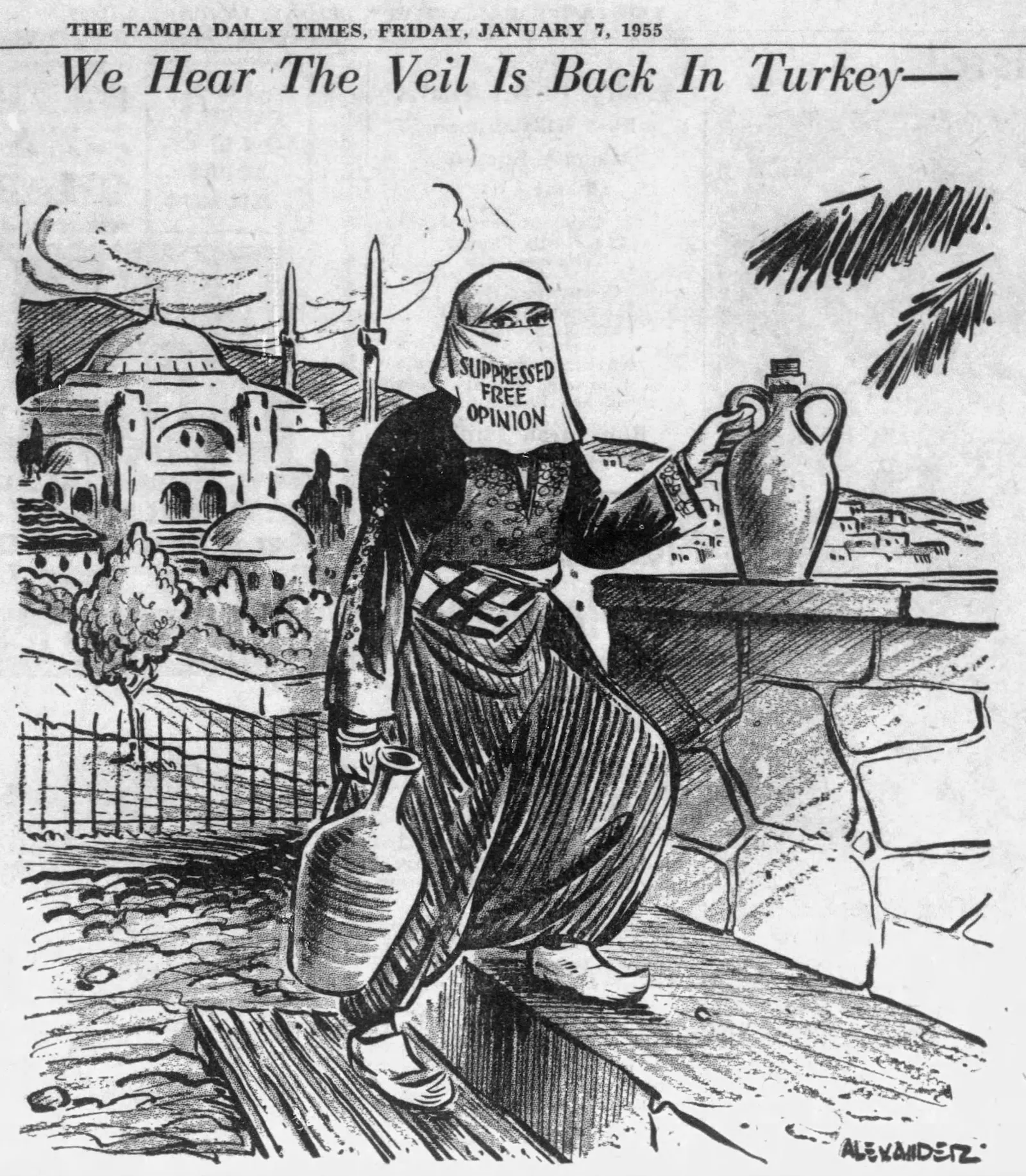 The issue of the veil and the rest of the manifestations that are considered religious hypocrites in recent decades, which we consider to be a rattle before the final death, the advocates of the veil ask the question, does the removal of the veil make progress, and then donate the answer to the question they asked in the negative, trying to prove the validity of their position by providing some examples of veiled women who made progress and glory according to their assessment of glory, which they considered a personal phenomenon, as they consider the heroism as a personal phenomenon, but progress, glory and heroism are not personal phenomena, but social phenomena, and it cannot be said that glory and progress were made in Egypt because so-and-so veiled, Egypt and other Arab countries are socially late, and for delay the reasons, including the recent venture that has spread more than its spread in Egypt in the days of Saad Zaghloul!
If progress is social, the decline and fall of nations or peoples is also social, and it is not permissible to comment social failure on the veil only, but this does not mean that the veil does not consecrate the disruption of the mind and thus contributes to the perpetuation of the fall and failure, comparing Egypt with Japan makes it a little clear, Egypt’s natural or esoteric wealth is greater than the wealth of Japan, but religion and religion and their accessories in Japan are less in the degrees of religion and religion and their annexes in Egypt and the difference here between 100% religion and its annexes in Egypt compared to the two religions and their annexes in Japan, because of the religion, religion, veil and their accessories, which is the low production of the Egyptian individual, compared to the other policy, there are many rightful questions, such as the question of which religion and the woman produces, and the human being, because of the fact that the woman is transformed by the family, and the relationship of the woman, and the relationship of the woman, and the disability of the woman, so that he produces the same, the woman, the way of the woman, the relationship of the woman, the way of which the woman produces, and the human being, so that the woman is divided, because of the relationship of the woman, and the relationship of the woman, and the fact that the woman is transformed, so that the woman produces, and the relationship of the woman, and the relationship of the woman, and the disability of the woman, something of the woman’s religion and the way of the woman, and the disability of the woman, the fact that the woman produces, and the relationship with the woman, so that the woman, the way of which the woman produces, and the humanity, the relationship of the woman, and the disability, the way of the woman, the way of religion and the vestrusion, the relationship of the woman, and the fact that the woman is transformed, and the relationship of the woman, and the disability of the woman, so that the relationship of the woman, and the disability of the woman, the way of the family, the fact that the woman produces, and the way of the woman, the relationship of the woman, and the disability of the woman, the way of the woman, the relationship of the woman, and the fact that the woman is transformed, and the female relationship, and the relationship of the woman, and the disability of the woman, the way of the woman, the fact that the woman is transformed, and the relationships of the woman, and the fact that the woman is transformed, and the relationship of the woman, and the relationship of the woman, and the way of the woman, and the relationship of the woman, and the fact that the woman is transformed, and the way to the way of the woman, and the relationship of the woman,
On the occasion of the subject of the veil, the following question must be asked, is the priority of form or reason and is veiling an imposition?, Is the removal of the veil and refusal to forcibly wear it wrong or a crime or a misdemeanor as was the case in Saudi Arabia and the criminalization of removing the veil or not wearing it is still a crime in Iran, Afghanistan and some other regions, on the other hand, there is a narrowing that is taking the utmost against the veil and veil, because veilation is practically forced and intimidated by the wrath of God and punishment in hell and so on, it is the banner of a black war against free will, the reason for the tightening of the veil in the world is not the dress in itself, but forcing women to wear a certain dress.
The strangest thing that was said in the controversy on the issue of removing the veil was what Sheikh Khaled al-Jindi, the former Grand Mufti of the Egyptian Republic, by inventing the term “insulting the veil” commenting on the fact that some girls took off the veil and launched it in the air to fall on the ground, or removed it by force, as it appeared in the image of the Iranian Mahsa Amini, what the soldier said is scary, especially for the veil, that it is a declaration of war on them and directing the shares of social violence to their chests, Khaled El-Gendi was not satisfied with the hypothesis of insulting, but expanded the sick hypothesis to consider the veil as a national flag, that is, the removal of the veil is similar to throwing the national flag in the garbage basket, that extremism by imposing the veil is a kind of blackmail and threat as Khaled Al-Jindi by saying “Who insults the symbol insults Muslims and people” His interest and lethality, is true if he says the opposite, that is, the punishment will be empty-
Religious figures insist on the hijab because it distinguishes the female believer—a follower of Muhammad—from others; in other words, it serves as a form of identity. Yet, what is the benefit of a harmful identity? Across much of the world, individuals suffer for being identified as followers of Muhammad, as this label is often associated with negative connotations rather than positive ones. These negatives include accusations of terrorism or illegal immigration, as well as the financial burden associated with the presence of refugees—costs that European populations are expected to shoulder. A refugee in Europe costs the state 5,400 euros per month; consequently, these populations are unwilling to bear the long-term expense of supporting millions of refugees. While Arab governments want refugees to remain in Europe, this very point lies at the heart of the current dispute between France and Algeria: France seeks to deport certain refugees, whereas Algeria wants them to stay in France. How can the actions of the Algerian government—a state not currently plagued by civil war—be understood? What kind of state refuses to allow its own citizens to return home? Are there any governments more despicable than those of Arab nations? Why do most Arab refugees throw their identification documents into the sea before reaching the shores of Europe? Through this, they aim to facilitate their asylum proceedings, as they have effectively become individuals without an identity; the fact that the hijab serves as an identity—as the sheikhs insist—makes obtaining a residence permit difficult, thereby denying them social benefits, housing, and other forms of support. Thus, the classification of the hijab as an identity works to the detriment of the woman who wears it—a woman already forced into exile by her own government. Even worse is the refusal of these countries to allow refugees to return to their homeland; are there any nations more despicable than those Arab