Mamdouh Bitar, Samir Sadek
The problems of religion are not limited to moderation, extremism, or formal religiosity, etc. Rather, they include many other aspects such as considering religion as a source of the laws of the land, i.e., legislation, and then considering the essence of religion as a social phenomenon and not a personal matter! In fact, religion cannot be social, but rather an expression of the person’s relationship with the religious unseen, The personal religious matter should not fill society, i.e., be considered a social phenomenon, When religion fills society, it closes the door to filling life with the necessary social materials appropriate to the era (time and place), such as politics, social guarantees, separation of powers, equality, democracy, freedom, etc.
Society is inherently diverse, There is a significant difference between individuals within a society who live together and a group of individuals who live alongside one another,The first type is capable of establishing and maintaining a state, while the second type is specific to the tribe or what is called pre-state, meaning it is incapable of building and managing a state, The first type is qualified to open up avenues for human interaction with political, social, military, economic, and other issues,The group of individuals is not qualified for this, In the tribe, which represents pre-statehood, its leader does not interact with others but rather imposes his will, and the flock must obey and submit, Religion that imposes faith, then obedience and submission, is tribal in nature, especially that religion which interferes in the small and large aspects of people’s lives, as the leader of the tribe or clan does , The structure of the tribe does not build a state, and from here came the slogan “Religion is for God and the homeland is for all,” or the slogan of separating religion from the state, The spirit of the tribe is different from the spirit of the state. Planting the spirit of the tribe in the heart of the state is deadly to the state and its heart.
Religion consists of constants and sacred things, Through these constants and sacred things, religion intervenes in the private and changing affairs of society from one time to another, Religious constants usually fail to deal with social changes, meaning that religion fails in its own way, that is, in its attempt to fix the changing and freeze it in its own image, Here, religion is transformed from being a servant of humanity to being served by humanity, Whoever refuses to become a servant rejects the constants and tries to abolish them, thus opening the way for development, that is, abolishing the social role of religion, And what remains of religion after abolishing its constants or abandoning the constants that represent its principles? Nothing remains of it, and it becomes a surplus that is unnecessary, that is, it abolishes itself.
Religion does not have the ability to easily abolish itself, because it cannot abolish its constants on which its men live and from which they live, Nor is there room for religion to transform into a dynamic, evolutionary political system as happened in Europe with what is called “social religion.” A religion that fills life or wants to fill life, as is the case in this region, will not live peacefully except by seclusion in the space of temples, If it is not placed in the cage of temples, it will fight and blood will be shed. Placing religion in temples is liberation and protection for it, and imprisoning it in civil life and its fluctuations is a crisis for it to the point of its destruction, that is, the destruction of its followers, A religion in crisis puts its followers in crisis!
When a society is filled with religion, faith takes precedence over everything, and faith becomes the sole consideration in the rigid, practically dead “life,” which religion tries to keep formally alive,There is no way to do this except by imposition, and no way to impose except by violence, That is, religion is practically a major source of violence, because violence is a method of interaction between faiths, Faith does not speak the language of dialogue or practice persuasion, but rather imposition, which negates reason and its objectivity, Faith is a translation of the concept of either kill or be killed, And can the formula of either kill or be killed be achieved without violence?
When a society is filled with religion, identities are reduced to a single identity originating from religion or sect,, At that point, religious identity becomes all-encompassing, Religious identity is based on faith, and one of its inevitable consequences is the attempt to eliminate other identities and create a single human being—the believer—in one direction only,It is the creation of a one-dimensional human being who eliminates the characteristic of choice, There is no benefit in democracy in managing religious groups, i.e., sects. Democracy was not created to manage the lives of sects, and the lives of sects are managed only by concepts such as overwhelming dominance, i.e., dictatorship! The sect was and still is an expression of the one-dimensional human being!
The first to examine the issue of one-dimensional man was the German-American philosopher Marcuse, Marcuse’s approach to the details was very different from what followed, Marcuse focused on the fact that capitalist ideology represents one dimension, based on his leftist orientation, which led him to consider it a representative of dead time, If Marcuse had lived longer, it would have been expected that he would have been somewhat freed from the prison of capitalism and thought about the harms of one dimension in other areas, such as the political field in primitive societies, which have no relation to capitalism and no relation to socialism, as is the case in this region, Tribalism was and still is plagued by one-dimensional leadership, and even the affliction of tribalism is no different from the religious affliction, which imprisoned itself in the brothel of the one sacred, i.e., one dimension, especially in backward regions,In these regions, such as the Arab region, there is no Western capitalism, which Marcuse was primarily concerned with, and even the capitalism that Marcuse accused of being a representative of one dimension was not as he thought and did not become as he expected.
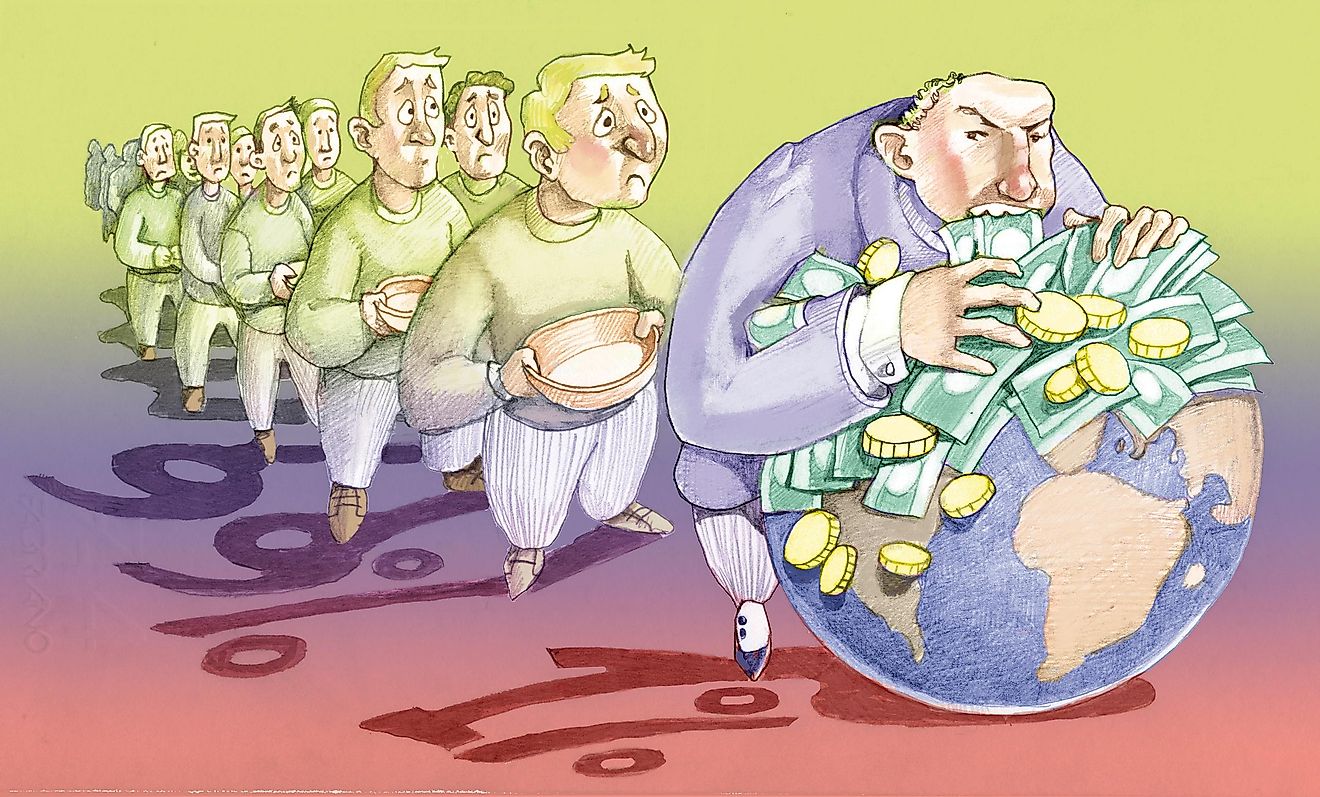
One of the factors contributing to the poverty and weakness of the peoples of this region was the absence of capitalism and consequently the absence of a bourgeoisie, i.e., a middle class, The wealthy in this region do not represent a capitalist class that had many positive aspects throughout the world, especially in Europe, The wealthy in this region represent a group of thieves and smugglers, i.e., a class above the law that plunders a class below the law, i.e., the poor, nothing more and nothing less!