
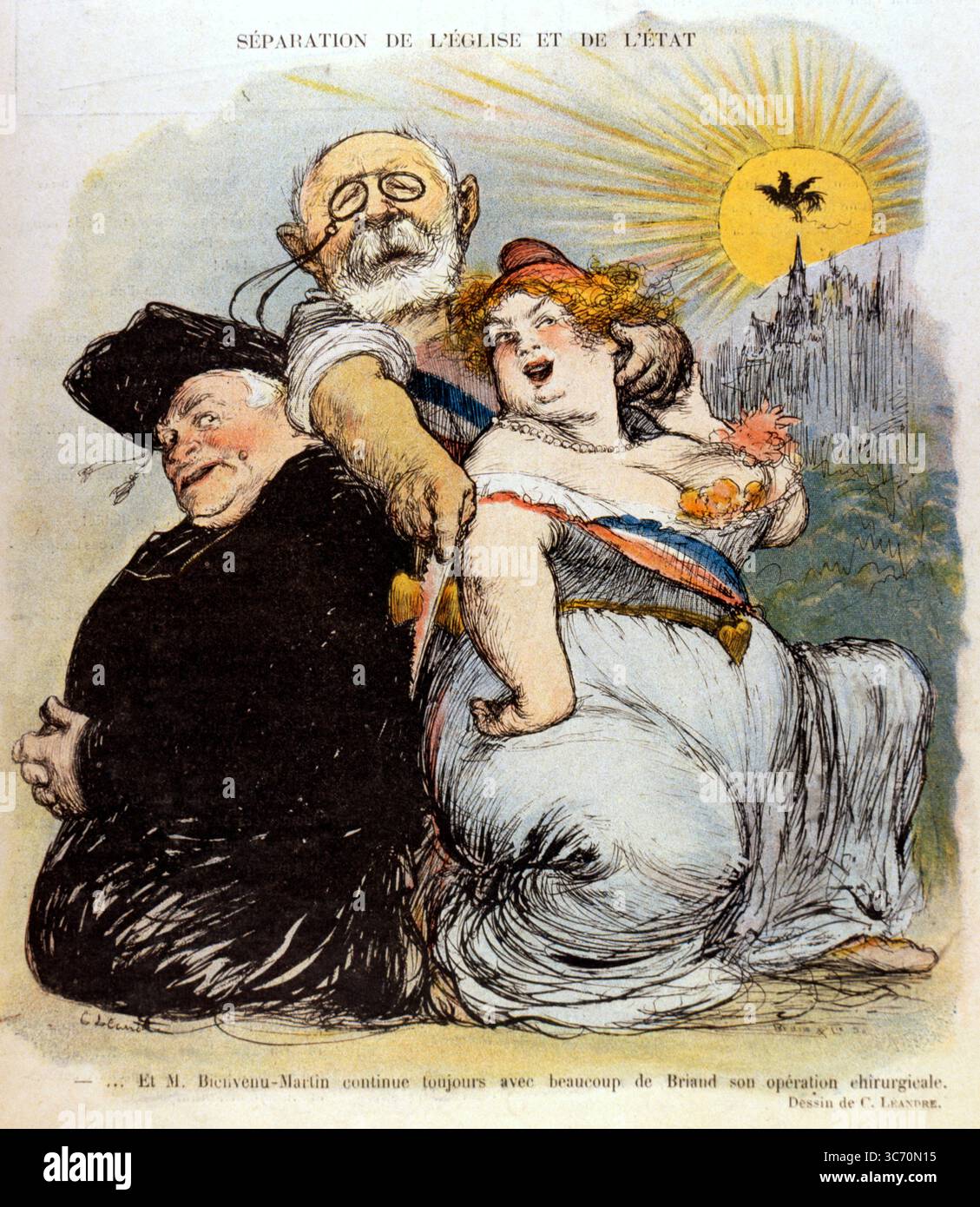
 There is not much thought and analysis in the political literature of the Levant (Greater Syria) regarding the separation of religion from the state, with the exception of the National Social Movement and especially the founder of this movement, Antoun Saadeh, who made the separation of religion from the state the first reform principle, The literature of the movement is very rich regarding the principle of separation, which analyzed and studied the issue in a depth that is unparalleled, The biggest obstacle to achieving social unity is the mixing of religious authority with temporal authority, and considering religious authorities as authorities of sovereignty in the state, and then the religious authority seizing the reins of power or seizing the reins of some of its powers at least.
The great battles of human liberation were those that took place between the interests of the people or societies and the interests of religious institutions armed with the principle of divine right and divine law in ruling the peoples, The religious institutions were not alone in using the principle of divine right and divine will, but the holy monarchy also used it, which claimed to derive its authority from the will of God and from the support of religious institutions for it, not from the people, in a quasi-state that has no separation between it and religion, and the rule is on behalf of God, not on behalf of the people.
Religious entities called states, such as the Caliphate, for example, clash with social nationalism, because they claim that the religious institution controls the entire body of believers, as was the case with the claims of the Papacy and the Caliphate previously. Religion does not care for the interests of a people or a specific society with a specific geography, The essence of religion is international and not limited to a specific society and a specific geography, A group of believers does not turn them into a state society in the modern and current sense of the word. Religion was and still is suitable for it when man was in the stage of barbarism or close to it, that is, in the pre-state stage, such as the tribal stage, But in the current cultural-political era, it no longer has that suitability.
This is the philosophy of the Syrian Social Nationalist Party regarding religion and the state, and this is its position, There is no party position on religious, philosophical, or theological ideas related to the mysteries of the soul, immortality, the Creator, and metaphysics, The position towards these matters is not suitable for a socio-political system such as a party or a state, but rather for individuals as persons in a society, not for society and its institutions, The idea of a religious-political university is contrary to nationalism in general and to Syrian Social Nationalism in particular, The adherence of some religious groups to religious theocracy or to a religious university turns them into groups with interests that conflict with the interests of other religious groups within the homeland, Consequently, the homeland is exposed either to fragmentation or the necessity of one interest dissolving into another, and thus the birth of the concept of hegemony, which represents a state of latent or cold war, The war awakens when conditions are ripe for awakening, and awakening is inevitable one day.
The religious university leads to the dismantling of the national university within the framework of the nation-state or the people or peoples, Nationalism is not founded on religion with an international essence that transcends geographical borders, nor is the nation-state founded on religion, Therefore, we see that the two largest religious universities in the world, Christianity and Islam, did not succeed as civil political universities, as they succeeded as spiritual cultural universities. There is no danger from the spiritual religious university, nor is there a danger to it through the separation of religion from the state, The political religious university represents a danger to the state, social unity, and the interests of the peoples, and this is what the reality of the political Brotherhood and other politicized doctrines has proven every day.
National social unity cannot be achieved within the framework of a religious state, either wholly or partially, A religious state is founded on inequality between groups that are not considered part of the state of law, The state is a state of citizens, not a state of believers, The interests of some believers do not align with the interests of all citizens, which are based on the principle of equality, It is not in the interest of the nation to translate the interests of some, regardless of their percentage, It is not permissible to include sectarian percentages in the balance of a political majority or minority, The balance of sects is different from the balance of politics, and the national interest is a political interest that depends on equality in rights and duties.
The unity of rights and duties with equality is the unity that guarantees the progress, stability, and steadfastness of the state of citizens., The unity of rights and duties is a translation of the unity of will and goals,Therefore, the second reform principle saw the prevention of religious figures from interfering in national politics and the judiciary, The third principle saw the necessity of removing barriers between different sects and doctrines. The fourth principle saw the abolition of feudalism and the organization of the national economy on the basis of production, fairness of work, and the preservation of the interests of the state, The fifth principle saw the preparation of an army that would be effective in defending the homeland, not in defending individuals. The concept of an army is different from the concept of a militia.