We have no valid reason to doubt the reality, or rather the “symbolism,” of the images and news flowing from social media pages, all of which demonstrate the Syrian hunger, that is, the loss of food security in terms of both quantity and quality. What kind of water do people drink to avoid dehydration? Are there any who can afford to buy necessary medicines or even pay the electricity bill?! Who doubts the reality of what we see in the images, what we read on social media platforms, and even what we see with the naked eye? Only those who have lost their conscience and their minds would doubt all of this. How can we doubt hunger and its consequences when we see the hungry among us and the sick among us everywhere? The catastrophe is not limited to a village, a town, a city, or a neighborhood. The generalized catastrophe is consuming people alive, burning them alive in cages, burying them alive. Thus, the country has turned into a large graveyard for the living, with an area of 185,000 square kilometers.
It is easy to demonstrate the barbarity of a savage, animalistic authority that will stop at nothing to survive. The few who benefit materially and morally from the Sunni rule still defend that criminal system, which graduated from the schools of Al-Qaeda, then ISIS, and recently from the immature Al-Nusra. In the visual depiction of the hungry and those who live in darkness in the age of electricity, we find no difference between an unfabricated image, a symbolic one, and a fabricated one in a direction that expresses, wholly or even partially, a bitter reality. Indeed, the images produced and fabricated by the hand of an artist or painter may be more expressive than the images produced by cameras. We find no greater triviality than the triviality of the supporters in their doubt about the reality of the images we see, the news we hear, and what we live and experience personally.

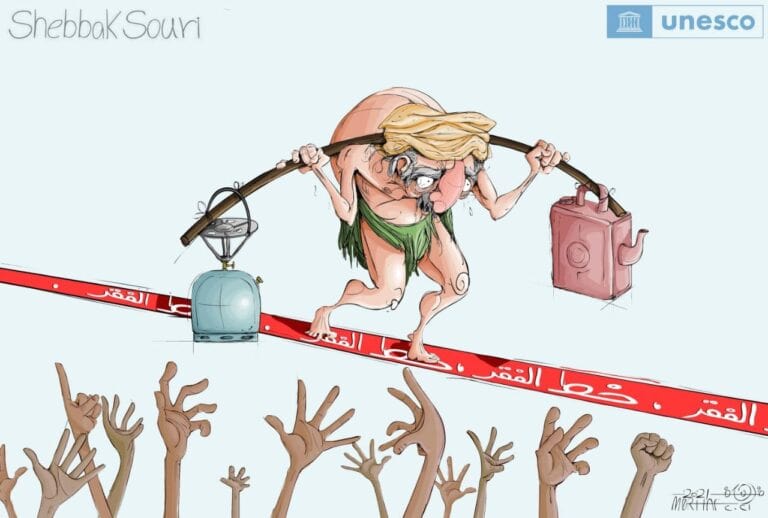 The appropriate topic is the topic of occasions. Now we have an occasion to talk about hunger in Syria, especially after it became widespread and a quantifiable reality. When a person does not have the means to finance his food and drink, he inevitably becomes hungry, regardless of the possibilities of corruption in providing enrichment for some and providing gluttony for others. Whoever studies the issue of income in Syria and compares it with the very necessary costs of life, reaches the conclusion that confirms the impossibility of life economically in Syria, not to mention the impossibility of life politically, security-wise, and socially in a society that has turned into flies and wolves.