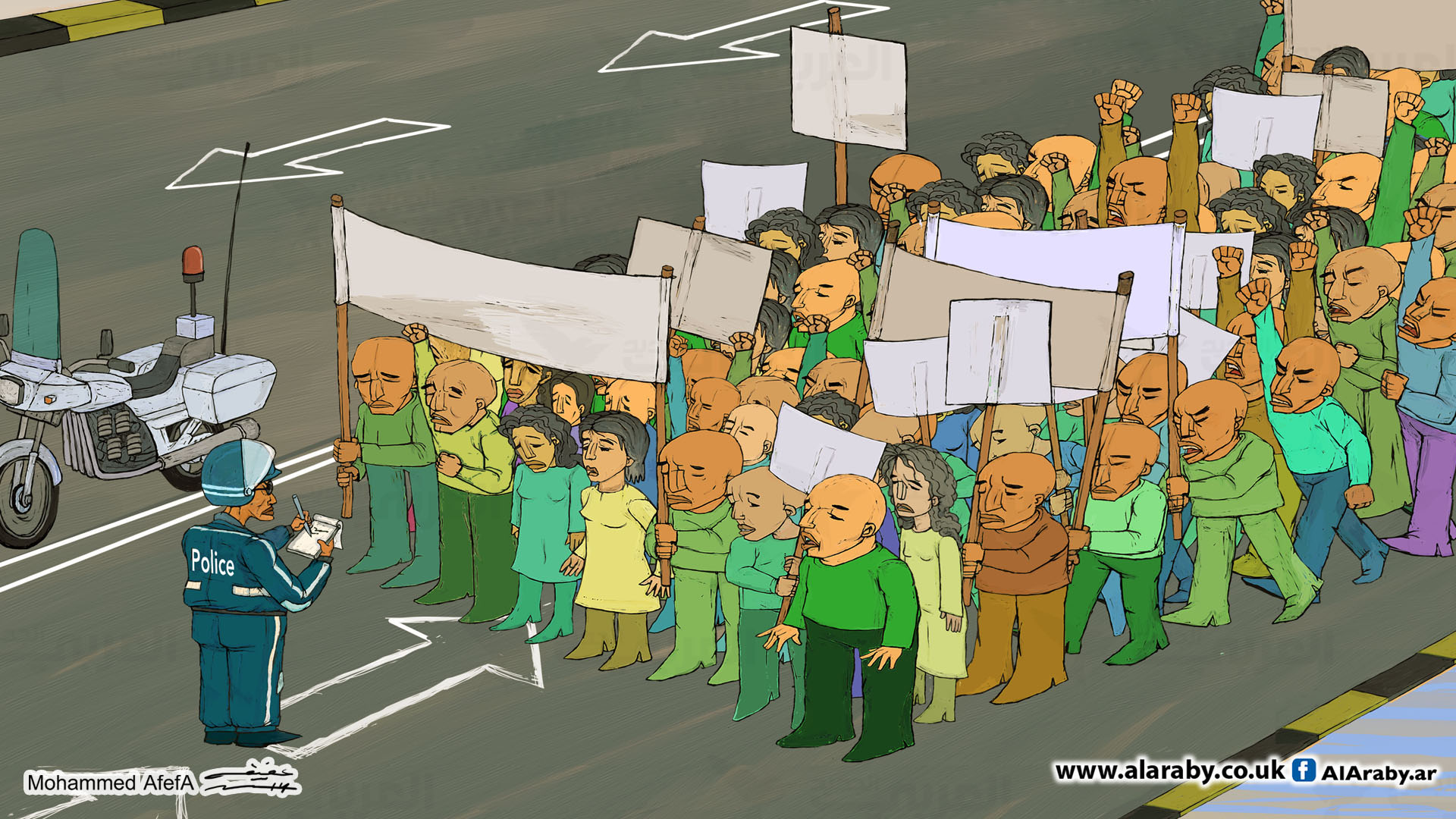
There is no doubt that the developments of the twentieth century led to the change of a fair number of regimes, but these developments were unable to influence the collective consciousness, and the collective consciousness was not affected by them, From here, it can be said that these movements, one of the beginnings of which was in Egypt in 1953, were not truly revolutions, but rather military coups designed to change a regime, Perhaps we are being unfair to the coup leaders when we ask more than that of them.
Undoubtedly, collective consciousness has changed and developed somewhat in recent decades, not at the hands of the military coup plotters, but at the hands of new media technologies, technologies that have contributed greatly to psychological liberation from tyranny,This liberation could not have been born under the whip of the old tyrant, nor under the whip of the new tyrant, who called himself a revolutionary and his movement a revolution.
The dictatorial revolutionary and his formal revolution only changed the name of the tyrant, The court poets remained as they were, and even the old vocabulary found use in the new regimes, such as Father Anwar Sadat, Brother Colonel Muammar, then deification, then the achievements of the leading party in confronting the conspiracies of colonialism, etc. Flattery of the new tyrant remained the same, and the team of privileges remained with new names as they were, and the authority of the verses remained, and even its frequency of use increased, because the revolutionary master was nothing but a fundamentalist disguised in a revolutionary mask, Therefore, there were alliances between these “revolutionary” regimes and religious fundamentalisms, The relationship between religious fundamentalism and the new fundamentalist regimes oscillated between harmony at times and hostility at other times, Here is Abdel Nasser introducing into Egyptian law everything the muslim Brotherhood wanted in the same year that Sayyid Qutb was executed, Models of this type are familiar in many Arab regimes!
The collective consciousness has changed relatively dramatically under the influence of modern media technologies, Secularism, which is no more than 30 years old in this region, threatens fundamentalism, which is decades old, The class of court poets is turning into a clownish tigress. The authority of verses is crumbling and turning into folkloric interludes, Whoever wants to accomplish all these developments and many others within 24 hours will fail, because accomplishing such great tasks in a short time is impossible.
A careful and in-depth look at the situation in general reveals the birth of a new thought, a thought that is still in its infancy, sometimes stumbling, which suggests to the pessimistic observer the absence of new thought, Superficial thought does not grasp the mechanisms of history and the speed of its developments, which the impatient individual perceives as absolute stillness, Whoever expects a magic wand mechanism from the social developments of peoples is deluded. Revolutions do not happen by decrees and wishes, Whoever expects a revolution to change consciousness must be patient, When Chinese Premier Zhou Enlai was asked about the French Revolution, he said, “It is still too early to judge this revolution.” This was hundreds of years after the outbreak of the French Revolution.
Some claim that the reason for the failure of some Arab “revolutions” was due to the lack of specific leaders for these revolutions, while we believe the opposite,The rejection of the figure of the inspiring leader, which in many cases has become chronic, is in itself a necessary revolution, as Guevara emphasized, It is a profound revolutionary achievement, a liberation from the individual model of inspiration and the sole leader, It is an immunity against regression to palaces and dictatorship, to which many true revolutionaries, such as Castro, who ruled for about 60 years, regressed, There may be, in terms of age-related development, some similarity between sexual impotence and political impotence.
In the new cultural context based on information technology and social communication, the positions of intellectuals on the subject of revolution can be divided into three categories:
First: The authoritarian intellectual, whose personal interests are linked to power, defends the regime until his last breath, Here, this intellectual confines himself to a parrot-like, caricatured scene, repeating the official narrative of the regimes, which did not see the people’s movements as a revolution, but rather as a conspiracy. Here, the intellectual of power relinquishes the system of knowledge in investigating the truth and championing the principles of freedom, and engages in the game of clientelism for power, that is, he turns into a “mercenary” for power, praising it and ignoring its mistakes, and thus loses his legitimacy and credibility.
Second: The critical intellectual, who finds himself, by virtue of his critical cognitive function, committed to his duties as a citizen defending freedom and social justice, This intellectual defends the revolutionary, enlightening, transformative thought and the legitimacy of the revolution of change and development, He contributes to confronting reactionism and traditionalism and fights the occupation of the past by the present, i.e. he confronts the culture of death and defends the culture of life.
Third: There is the collective field intellectual, whose activity is not defined by the ideology of theory, nor does he separate between theory and practice, or between elites and the people, or between the citizen and the thinker, The collective intellectual is dynamic and rational, and he is practical and does not define his activity by a specific party program, He is generally open-minded and a voice for the voiceless!