Authoritarian violence and oppositional violence
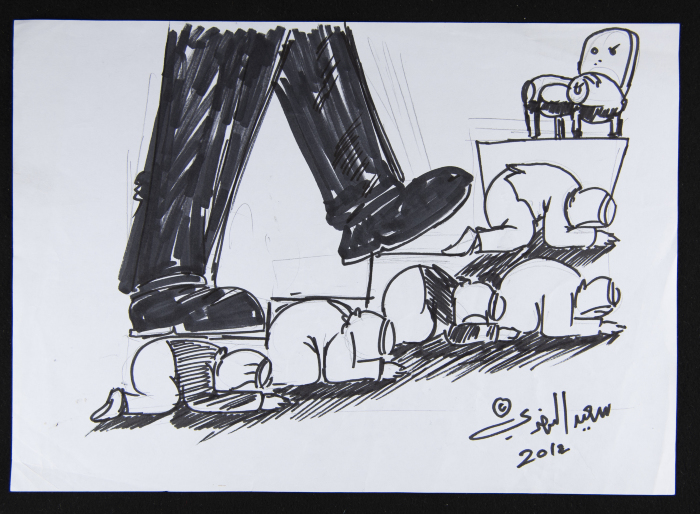 There are no revolutionary options or means, but there is a revolutionary form and a revolutionary means that apply to the form of the cause of the revolution. When the people were ruled by the sword, where there were no elections or parties, the ruled revolted by the sword and the ruler confronted them with the sword. Violence was the only means used by the people in their revolutions in the past, but this means unfortunately continues in some areas that have deviated from historical development and remained outside the laws and rules of history. In Syria, for example, there are no peaceful democratic means of change… civil disobedience… demonstrations… and there is no place in the country outside of prison for peaceful civil renewal forces such as the opposition. Until 2011, opposition was a charge punishable by imprisonment for decades, and the situation did not change even after the fall of the Assad regime. Opposition forces cannot express themselves without being eliminated, even physically. The prevalence of the idea of violence as a means of revolution is an image of the prevalence of the idea of violence as a means of rule, and the prevalence of authoritarian violence will be met with the prevalence of revolutionary violence whether we like it or not.
In general, it is difficult for a peaceful revolution to continue in all the entities of this region, because the unjust regime that the revolution wants to remove is violent by nature, and in most or all cases, it was born into a military coup from the womb of violence. This was the rule in effect in a region that was politically ignorant and addicted to violence and the sword. Violence does not respect people’s choices, but rather imposes its choices on them!
The Arab situation in general has been in need for a long time to achieve revolutionary change and development, so there was the beginning of a revolution in Syria. This revolution was wrested from the hand of a weak revolutionary consciousness and moved very easily from the hand of peace to the hand of war. The bitter surprise here is that the men of war are the fiercest enemies of the 2011 revolution. The men of war in Syria did not represent a continuation of the revolution by other means, because their goals do not represent a contradiction to the regime, but rather a consecration of what is uglier than the regime. Their goals represent the opposite of the spirit and goal of the 2011 revolution, which logically, and in a certain circumstance, should have been militarized by its own army and not by the army of its opposite, religious fundamentalism.
Our attention was drawn to what the Syrian thinker George Tarabishi said, who anticipated the Arab Spring by a long time. Based on his analysis of the Arab situation, Tarabishi believed that the absence of a bourgeois alternative, i.e., the middle class, in this region, would inevitably lead to the rise of fundamentalism, especially in the concrete conditions of the Arab world, whose destinies have been controlled, for quite some time now, by the ideological and cultural exploitation of petrodollars for the benefit of Muhammadan fundamentalism. The violence necessary to overthrow a regime characterized by violence did not find anyone in the 2011 revolutionaries who could practice it, so it easily passed into the hands of fundamentalism experienced in the scourge of wars and violence. In the face of the 2011 revolution, it practiced violence and ended any effect of this revolution.
It is worth noting that Tarabishi meant here by “bourgeoisie” the middle class of craftsmen and owners of small and medium-sized enterprises, and he did not mean the parasitic bourgeoisie of capital. The French Revolution, for example, was a revolution of the bourgeoisie against the nobility and the clergy. Whoever searches for the bourgeoisie in Syria, i.e. the middle class, will not find it, but will find a class parallel to the nobility, the class of the newly rich, who owned more than 90% of the Syrian national wealth, a class that does not resemble the French nobility except in terms of material ownership. It is a class of smugglers, brokers, and criminals, the thugs of money and business, who contracted with the clergy to share power. The power brokers did not skimp on the clergy with anything below the level of the throne. They have the personal status law, and they have whatever they want of mosques, material glory, Quran memorization schools, and the first rows at every party of drumming and trumpeting. However, they must be careful not to approach the throne, as Sayyid Qutb tried to approach, as his share was… gallows
Humanity has evolved and methods of governance have evolved, and consequently methods of revolution have evolved. There are cases that require the combination of two weapons: the sword and the pen. No revolution has succeeded with the sword alone, but rather the pen had a great degree of intellectual enlightenment power, such that the pen was able to spread new intellectual values and remove the character of stagnation and subservience from people’s minds. The French Revolution did not succeed with the guillotine of Danton, Marat and Robespierre, but with the pen of Rousseau and Spinoza. In the swamp of religious companions, no flowers grow on Abdul Raziq, but the algae of Ibn Taymiyyah, Sayyid Qutb and Mawdudi multiply. The pen in this country was greatly hindered, and the production of the pen was only rarely able to penetrate the siege imposed by dictatorships on people’s minds. The Assad monarchy completely prevented the circulation of thought and only allowed the chants of glorification, fabrication, applause and deification, until there was another god in the country. For this reason and other reasons, the country left history, which means not It is unable to contribute anything to human history , meaning that it is sterile and castrated for a long time. The history of the Arabs as a whole was a history of exit from history, meaning their lack of civilizational progress, their inability to influence human history, and even their inability to confront the historical challenges that arise naturally in all human groups.
The conquests did not represent victory, but rather defeat. The conquests did not provide humanity with anything but evil, problems, death, blood, and humiliation. The Bedouin Arabs cannot be proud of what made them happy and saddened the rest of humanity. If the mechanism of the Bedouin Arabs’ pride in the conquests, spoils of war, and the capture of girls was correct, then any criminal thief and rapist would be proud of his crimes, robbery, and rape. The rise of the Arab Bedouin Empire was accompanied by the rise of classes of wealth and privileges, so that Ibn Abdullah became a billionaire through a fifth of the spoils, as Sheikh Wagdi Ghoneim said. If a raid by 800 mujahidin led to his stealing 1,000 dinars, Ibn Abdullah’s share would have been 200 dinars, compared to each mujahid’s share of one dinar. Despite this, the conquests led to a flood of money and spoils into the treasuries, especially in the Umayyad era, when the lines separating the caliph’s money from the treasury’s money were dissolved. All of this led to the growth of the class of wealthy thieves, as is the case now. In most Arab entities.
Views: 416