Human rights in this era are subject to the effects of two opposing forces, The first is terrorism in its blatant, modern form, beginning with Bin Laden’s bombing of the towers, which represents a development of terrorism that has existed for ages, and which represents a flagrant attack on basic human rights, The second is combating terrorism in ways and means that sometimes do not adhere to the standards imposed by international legitimacy, which suffered a setback after 9/11/2001, after it was affected by the repercussions of the awakening of a new terrorism, the likes of which history has never known.
Human rights must be the main feature of international politics, and the primary international actor, within and outside every country and everywhere, and must be free from the traditions of power politics and from selfishness, especially from the principle of particularities that characterizes the official Middle Eastern local view of human rights.
Regional particularities conflict with the universality of human rights known since 1948 and developed in 1966, which pertains to civil and political rights, such as the rights to liberty, life, belief, expression, organization and voting, then economic, social and cultural rights, such as the rights to work, education and treatment, and finally the category of peoples’ rights or collective rights, such as the right to self-determination and the right to live in peace. In general, it cannot be said that all countries give the same degree of importance to all the mentioned rights, nor do all countries adopt the protection of all these rights or even recognize them.
Historically, it can be said that modern Western civilization has been the most proactive in adopting and defending human rights in this era , In contrast, Arab countries have been the least proactive in adopting and defending human rights from ancient times until now, despite the opportunities available to Arab countries to join the system that serves them, or rather, serves everyone, i.e., humanity. Their interaction with Western civilization has been unhealthy, hesitant, and resistant. They have not benefited from it, considering it a “pollution,” and they have not realized that their renaissance and progress are impossible without benefiting from the civilizational experiences of others, especially the Western civilization, which now holds the reins of historical initiative and the vital driving force in all areas of life: economics, society, politics, culture, etc.
Freedom is the origin of all human rights, Bread has no taste without freedom, and freedom has no meaning without bread, Thus, the Arab states have failed to practice freedom, and they have failed to produce bread. Despite this, they remain in their isolation and seclusion, insisting on their backwardness and relying on the Creator!
If we take the Universal Declaration of Islamic Human Rights of 1981, we would find strange and wondrous things, The first of these was considering the source of human rights to be divine, While the declaration was supposed to examine and scrutinize human rights, we see it discussing the rights of God, Among the rights of God is the call for believers to submit to the will of God, which was expressed in the Quran and by the Seal of the Prophets, The declaration states:
We Muslims…etc., as if human rights pertain only to Muslims! We begin with our servitude to God, the One, the Almighty, as if servitude were a human right, Is the attribute “the Almighty” a praiseworthy attribute meant to glorify the Creator, or is it meant to denigrate Him? Among the rights proclaimed in the statement is the right to believe that God is their Guardian in this world and the Hereafter, that all will return to Him, and that He alone possesses the power to guide and rectify humanity, Then comes the belief in the true religion… Is belief in the true religion a human right? What then should be done with atheists? Then comes the acceptance of the human mind’s inability to devise the most upright way of life, Is this false admission of inadequacy a human right? Then comes the starting point of knowing that God has favored believers over many of His creation. Is the certainty that God has favored believers over others a human right? The Creator does not favor one type of His creation over another. Favoritism is not a human right!

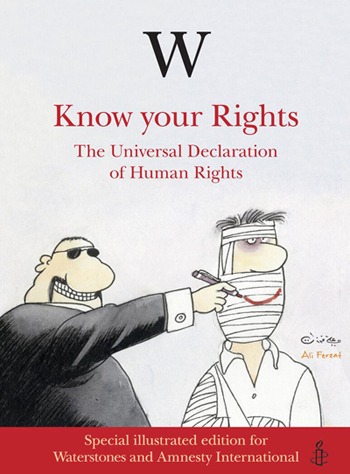 Human rights in this era are subject to the effects of two opposing forces, The first is terrorism in its blatant, modern form, beginning with Bin Laden’s bombing of the towers, which represents a development of terrorism that has existed for ages, and which represents a flagrant attack on basic human rights, The second is combating terrorism in ways and means that sometimes do not adhere to the standards imposed by international legitimacy, which suffered a setback after 9/11/2001, after it was affected by the repercussions of the awakening of a new terrorism, the likes of which history has never known.